A guest who books a villa doesn't think they're booking the materials. They think they're booking the pool, the terrace, the walk to the beach. But what they remember, what turns into this place felt different in a review they write three days after they leave, is rarely any of those things. It's the texture of the space around them. The weight of the door. The cool of a stone floor underfoot at the hottest hour. The materials were doing the work the whole time; the guest just never thought to credit them.
Materials are signals
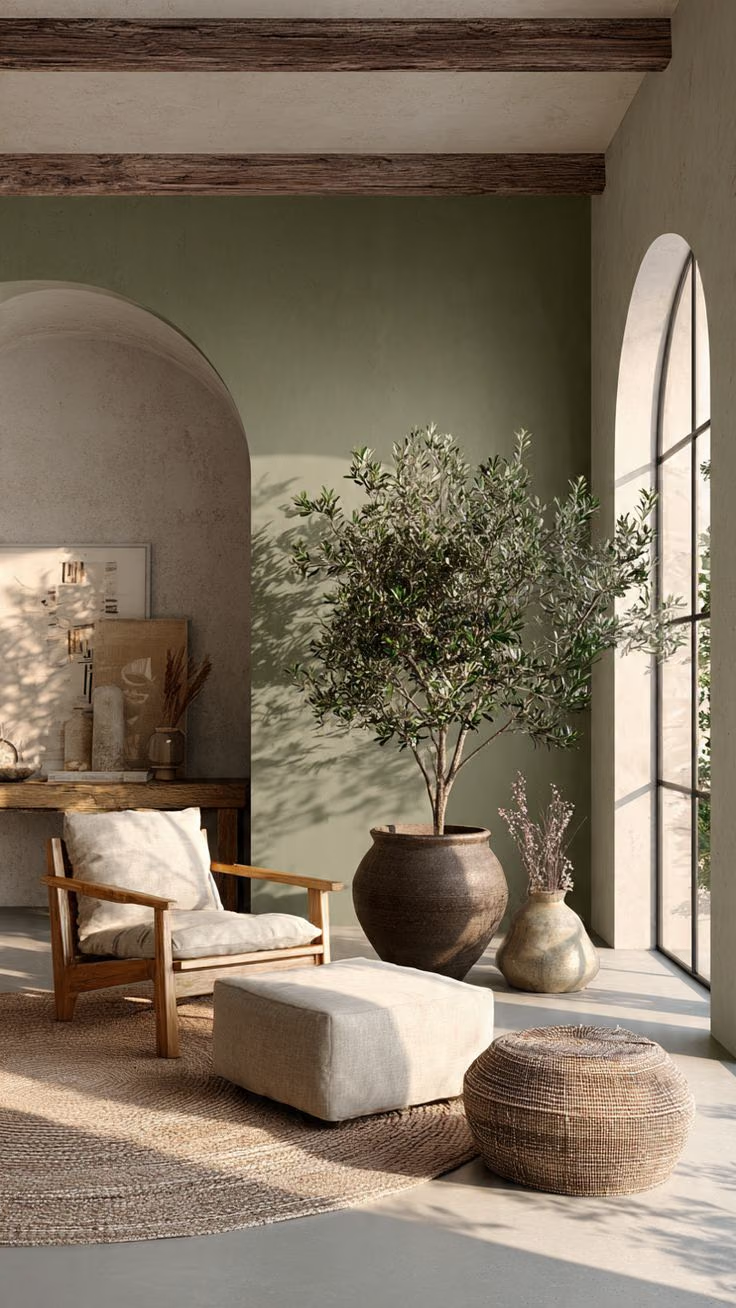
Long before a guest forms a conscious opinion, their body has already read the room. Natural stone says this building has stood here a long time, and it will stand a while longer. Unfinished linen says nothing here is trying too hard. A length of olive wood says someone chose this, and probably carried it home from somewhere. None of these are decorating decisions. They're hosting decisions, the first thing you say to a guest before you've said anything at all.
Synthetic surfaces send signals too, and guests read those just as fluently. The laminate that photographs like oak but sounds hollow under a glass. The veneer that chips at one corner to show the chipboard underneath. A guest may not be able to put a finger on what feels off, but the impression registers all the same, and it quietly colours how the whole stay is remembered.
What synthetic materials can't replicate
The pleasures of natural material are stubbornly physical. The give of a marble sill under your palm on a hot afternoon. The way a terracotta floor pulls the heat out of your feet when you come in from the sun. The faint smell of a cedar wardrobe when you open it to hang a shirt. There's no amenity specification that reproduces any of this, no checkbox on a listing for a floor that feels good barefoot.
And yet these are precisely the things guests reach for when they write the review and find themselves short of words. They don't write "the limestone had lovely thermal mass." They write "I can't explain it, it just felt calm in there." That sentence is worth more than any amenity you could list, and you can't buy it off a shelf.
Amenities tell a guest what a property has. Materials tell a guest where they are. Only one of those is something they'll still feel a week after they've gone home.
The advantage hiding in plain sight
Here is the part that should make any host sit up: the materials that do this work are usually already around you. Whatever region you let a room in, there is a local stone, a native timber, a clay, a cloth that belongs to that place. You rarely have to import anything to build a space that feels rooted. More often you simply have to stop covering up what is already there.
A property that leans into local material isn't chasing a trend off an interior design feed. It's speaking the language of the place a guest travelled all that way to be in. The effect lands as something close to relief: warmth, weight, the sense of having arrived somewhere that is unmistakably here and nowhere else. That feeling is the whole reason they booked your corner of the world instead of a city hotel that could be anywhere. Give it to them in the walls and the floors, and the rest of the stay has a foundation to stand on.
What natural materials ask of you in return
Honesty demands the other half of this, and here natural materials have a quiet advantage that surprises people. They are not maintenance-free. Stone wants sealing now and then, wood likes oiling before it greys, linen needs laundering and the occasional repair. But set against a laminate that has to stay flawless to stay acceptable, natural materials are far more forgiving. A scratch in solid oak is not damage the way a scratch through veneer is. It is simply the next mark in a surface that was always going to gather them.
This is the part worth leaning into rather than fighting. A worn wooden table tells a story. A stone step dished slightly in the middle from years of footfall reads as belonging, not as neglect. Embrace the perfect imperfections, and the very things that would ruin a synthetic surface become what gives a natural one its character. Kept reasonably, these materials last for generations, and more often than not they age far more gracefully than whatever you would have bought to replace them.
There is still a line, of course. Patina is not the same as neglect, and outdoors especially, a piece left wholly untouched for a season slips from characterful to abandoned. The catch is that a host who lives with a place every day is the last person likely to see the day it crossed over, which is exactly why an outside eye is worth borrowing from time to time.
None of this is an argument for a renovation. It's an argument for choosing surfaces that do something for your guest, and then keeping them well enough that they keep doing it. Natural materials will carry a property for decades. They only ask to be looked after along the way.
Natural materials don't date the way a styling choice does. Kept properly they deepen: the wood darkens, the stone wears smooth where hands and feet have passed, and the place gathers the kind of lived-in calm that no newly-fitted interior can fake. That is the environment that turns up, review after review, as the line every host wants and few can engineer on purpose: I can't explain it. It just felt right.